
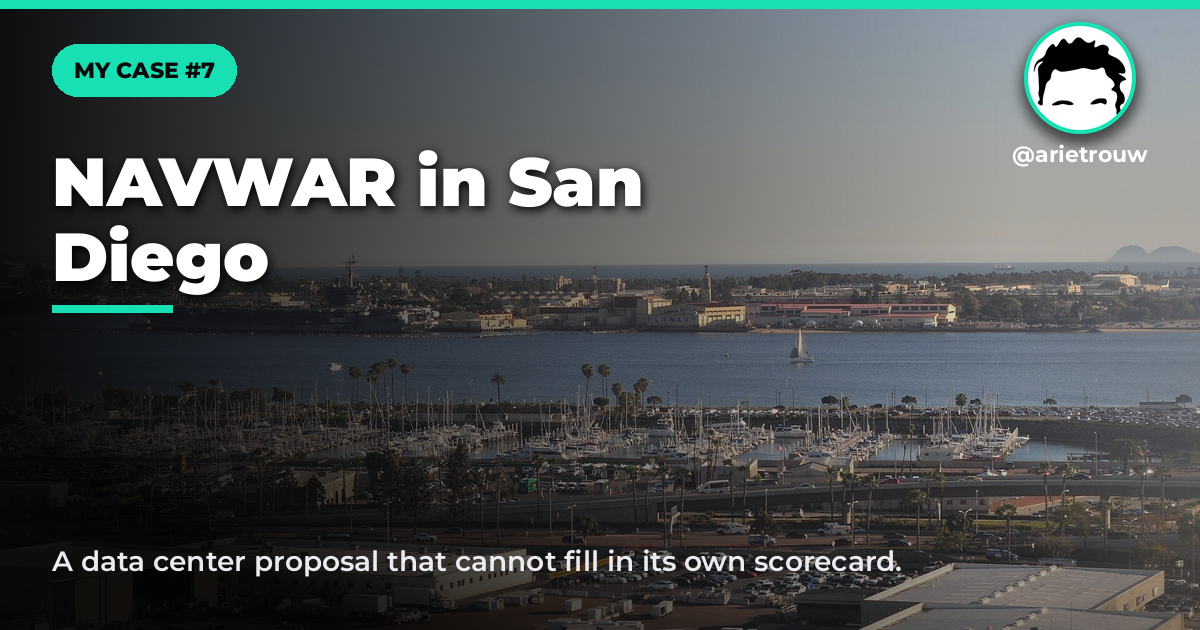

Case #7 in my data center series, NAVWAR, San Diego, CA. Part of My Case. The blank template is here.
This one is local. I live in San Diego County, and the Navy’s Old Town campus is where a possible 400 MW data center is being floated. It is the example I built the template on, so it is the one I know best, and also the one with the most blanks.
How to read this. Claims by companies, officials, and advocacy groups are labeled as claims. Where I could not find a number in the sources I opened, I wrote it down as an unknown and turned it into a question. Anything in a “My lean” column, and the conclusion, is my position on the evidence, and I am open to changing it. Facts are as reported through Oct 29, 2026.
The short version
On the public record, the NAVWAR data center cannot yet be scored. The developer answered the community-benefit questions with “TBD,” no tenant is signed, and nobody has said who pays for the grid. A proposal that cannot fill in its own scorecard has not passed the net-benefit test, whatever you think of AI.
Key numbers
- 400 MW Proposed capacity (Idea only. No approved project, no tenant [1][3][9])
- 7.7% Of SDG&E’s record peak (5,209 MW on Sept 9, 2026 [10])
- 60–140 Permanent jobs, direct (USC benchmark of 0.15–0.35 per MW [17])
- TBD Community benefits (Developer’s own answer in emails [1])
For the five-step test I use below, see the framework template. Most tables have a “My lean” column so you can see where my reasoning goes and argue with it.
The project
- What: A possible 400 MW data center, one of several ideas for redeveloping the Navy’s Old Town Campus. Manchester says no final project has been approved [1][3].
- Where: Navy Old Town Campus, about 70 acres between Pacific Highway and I-5, home to NAVWAR. Two parcels: about 47 acres and about 22 acres [3][4].
- Developer: Manchester Financial Group and Edgemoor Infrastructure & Real Estate (an affiliate of Clark Construction). In exclusive talks with the Navy since 2023 [6][8].
- Deal structure: Developer builds a new NAVWAR headquarters and gets a 99-year lease on the rest. The Navy says this needs no congressional appropriation, which limits Congress’s leverage [3][4][8].
- Where a data center would go: On part of the 22-acre parcel. Housing and other uses would go on the larger parcel [3].
- Phasing: Floated as 100 MW increments about every six months. No tenant is committed [1][9].
- Developer’s experience: “We’re hotel developers. We’re not in the data center space,” said CEO Ted Eldredge [1].
- Review: Navy NEPA review. A revised Draft Environmental Impact Statement is expected in 2027 [4][9].
- City response: Mayor’s executive order on Oct 22. Council passed a 45-day data center moratorium on Oct 27, with options to renew. It cannot reach federal land [5][7].
Step 1: Define the community
| Scale | What they get and what they carry | Who decides | My lean |
|---|---|---|---|
| Arie’s neighborhood (rural, residential, 15–20 min away) | No construction or operations work nearby. Shares in any rate effect, because SDG&E rates are set across its service territory (my inference, to be confirmed with SDG&E). No noise or heat. | Nothing beyond a vote and public comment. | No. Costs without local benefit. |
| Old Town / Midway neighbors | Noise, heat, traffic, a land-use change on a transit-adjacent site. A Navy spokesperson told the Old Town planning group to “be prepared for something quite modern” [6]. | Planning groups are advisory. The city has no zoning authority on federal land [5][6]. | No, unless the net-benefit test is passed with hard commitments. |
| City of San Diego | Water customers (the city imports up to 90% of its water [20]), budget pressure [13], housing goals. The council voted unanimously for a moratorium that exempts NAVWAR [5][6]. | Only through the Navy’s NEPA comment process, state utility regulation, and politics. | Conditional. The city carries risk without control. |
| SDG&E territory / San Diego County | The pool of ratepayers, jobs, and tax base. Peak-load and reliability effects. A record 5,209 MW peak this September came with localized outages [10]. | The CPUC sets SDG&E’s rates and rules. New state laws direct it to write data center tariffs [22]. | Conditional yes, if costs are a fraction of benefits and the developer pays for the grid. |
| State of California | Passed seven data center bills on Sept 21, 2026 covering rates, water, and energy reporting. No jurisdiction over federal land [5][22]. | Legislature, CPUC, Energy Commission. | Use the levers it does have, mainly SDG&E’s tariff. |
| Federal (Navy, White House) | Leases the land for an in-kind headquarters. The President is pushing data centers on federal land, where local opposition cannot block them [5]. | The Navy decides after NEPA review. Congress has little leverage [4]. | The public should demand the Navy run the same net-benefit test. |
Step 2: Net-benefit test
Costs first. Each row says who carries it, what the record shows, and where the gap is.
| Cost | Who bears it | Evidence | My lean |
|---|---|---|---|
| Grid capacity and upgrades | Presumably all SDG&E ratepayers unless the developer pays up front. Unknown which. | 400 MW is about 320,000 homes of demand [1] and 7.7% of the record system peak [10], running around the clock rather than just at peak. SDG&E says it will upgrade the grid for any large customer, and declined to comment on this one [1][2]. Manchester asked SDG&E for an engineering study [1]. Unknown – who pays for upgrades. | Developer pays all upgrade costs before connection, in a signed agreement. No signed cost allocation, no yes. |
| Electricity rates | All ratepayers, if costs are shifted. | SDG&E’s average residential rate was 46.4¢/kWh in April 2026 [11]. Community Power quoted the developer up to 11¢/kWh for energy, about $1M a day at full load, excluding other charges [1]. That is generation only, so it cannot be compared with a bundled bill. Unknown – net effect on other customers’ rates. The CPUC’s review of cost shifting is due Jan 1, 2027 [22]. | Ratepayers must come out whole, with exit fees and collateral so the cost does not strand. |
| Backup power and air quality | Old Town and Midway neighbors. | Developers say there would be on-site backup power, possibly gas generators. A fully renewable supply is “unlikely” [1]. Unknown – number, size, run hours, and which air permits apply on federal land. | No fossil-fuel backup near homes, or it is a deal-breaker. |
| Water | City water customers. | Using the 2023 US data center average of 0.375 liters per kWh [19], 400 MW at full load is about 1,065 acre-feet a year on site, about 0.5% of the city’s projected total demand of 202,865 acre-feet [25]. This is an illustration, not a forecast. The cooling design is unconfirmed [9]. Power-plant water is roughly 12 times larger nationally [19]. The city’s water rates rose 14.7% on Jan 1, 2026 [20]. The Water Authority says supplies are sufficient through 2050 [21]. Unknown – cooling design and water source. | Recycled water only, no drinking water for cooling. The state’s new water-assessment law shows what to ask for [22]. |
| Noise, heat, footprint | Immediate neighbors. | A 210 MW QTS campus in Phoenix sits on 80 acres [1]. Whether 400 MW fits on the 22-acre parcel is unclear. Elo-Rivera calls the North Park data center a “dead zone” on the street [5]. Unknown – building heights, acoustic limits, heat reuse. | Binding noise and setback standards, measured at the property line. |
| Process and trust | Public and elected officials. | The developer talked to SDG&E and Community Power before elected leaders knew. Community Power told its board “no” in April and May about pipeline projects [1][2]. | Disclose early. A federal process that skips the public is a cost on its own. |
| Speculation risk | Public, if the project stalls or is stranded. | No tenant is committed. Researcher Jonathan Koomey calls the current data center rush a speculative “gold rush” [1]. | Require a signed tenant and financing before any grid work. |
Now the benefits.
| Benefit | Who gets it | Evidence | My lean |
|---|---|---|---|
| Lease and tax revenue | The Navy gets a new headquarters in kind [1][8]. Revenue to the city or county is unknown. | California generally taxes private leaseholds on public land, but not inside a federal enclave, and it depends on when the land was ceded [16]. Unknown – NAVWAR’s jurisdiction status, whether the servers are taxed locally, any payments in lieu of tax. | Show the money in writing. If the city and county get nothing, it is a pure cost. |
| Construction jobs and spend | Regional building trades. | Benchmarks run 0.7–2.0 peak workers per MW, so about 280–800 at 400 MW [17]. The project cost is undisclosed [9]. Union or local-hire commitments are “TBD” [1]. | Real, but temporary. Require a project labor agreement and local hire in writing. |
| Permanent jobs | County workforce. | USC benchmarks give 0.15–0.35 permanent staff per MW, about 60–140 direct at 400 MW [17]. A UK think tank finds about 1.2 per MW (480), and industry claims 8.5 per MW (3,400), and both dispute each other [18]. Unknown – the developer’s actual count. | Binding headcount and wage commitments, not models. |
| Grid investment | Possibly all ratepayers. | Upgrades could add capacity others use, or could be stranded. State law now has the CPUC assessing stranded grid assets [22][26]. Unknown – what SDG&E would build and where. | Credit only what is shared and used, not what the data center needs alone. |
| Community benefits | Neighbors, schools, the city. | Asked about local jobs, union labor, and school partnerships, the developers wrote “TBD,” pending a tenant [1]. | No benefits agreement, no vote of confidence. |
Back-of-envelope calculator
Swap in your own numbers to size any proposal, not just this one. Defaults are the NAVWAR figures. Load factor of 100% is the upper bound.
Inputs (defaults)
- Capacity (MW): 400
- Load factor (%): 100
- Energy price ($/kWh): 0.11
- Direct water (L/kWh): 0.375
What they give
- Share of SDG&E record peak (5,209 MW): 7.7%
- Annual energy: 3,504 GWh, 21% of SDG&E’s 2024 total sales and deliveries (16,691 GWh) [12]
- Daily energy cost at that price: $1,056,000
- Direct water, on site: 1,065 acre-feet a year, 0.53% of the city’s projected total demand of 202,865 acre-feet [25]
- Permanent jobs, direct: 60–140 (0.15–0.35 per MW) [17]
- Peak construction workers, direct: 280–800 (0.7–2.0 per MW) [17]
Step 3: Weight by need
| Indicator | What the data says | What it means for the weighting | My lean |
|---|---|---|---|
| County unemployment | 4.7% in September 2026, versus 5.1% for California and 4.0% for the US. About 78,200 people unemployed [14]. | Moderate need. Better than the state, a bit worse than the nation. 60–140 permanent jobs would be 0.1–0.2% of the unemployed. | Jobs alone do not carry the case. |
| City budget | The FY2027 gap grew from $88.8M to $118.0M. A $318M structural deficit last year was mostly closed through cuts [13]. | High need for revenue. But the revenue from this project to the city is unknown. | Need is real. The project has not shown it meets it. |
| Electricity affordability | Average residential rate of 46.4¢/kWh [11]. | Rate-sensitive community. Raises the bar for cost shifting. | Costs that touch rates count extra. |
| Housing | Council members, Rep. Peters, and the developer all call housing a priority [3][4][5]. Unknown – current vacancy and rent numbers were not pulled for this page. | High stated need. Put the data in before final weighting. | Weights the opportunity cost in step 4 more heavily. |
Step 4: Opportunity cost
| Alternative | What the record shows | My lean |
|---|---|---|
| Housing and mixed use | The Navy’s 2021 Draft EIS studied 4,400 to 10,000 homes across the whole site, in 30-year build-outs [15]. The CEO says it “could include thousands of multi-family homes” [3]. Rep. Peters wants a “mini downtown” beside the Old Town Transit Center [4]. | The strongest alternative. Site is next to transit. |
| Data center on only the 22-acre parcel | Manchester says any data center would sit on part of the 22-acre parcel, with housing on the larger one [3]. If density were uniform, 22 of about 69 acres is about 32%, or roughly 1,400–3,200 homes (my arithmetic on the 2021 range, not a plan). | The real trade is smaller than “data center versus housing.” Ask for the number. |
| NAVWAR-only renovation | The Navy’s Alternative 1 renovates two 310,000 sq ft buildings and builds no private development [15]. | The baseline for judging whether the public-private deal is worth it. |
| Siting elsewhere | Peters: it “belongs in a more remote, industrial place” [4]. California data centers are usually under 100 MW [22]. An Imperial County proposal is 330 MW [1]. | If it gets built somewhere, make the question about where it does the least harm. |
| A 99-year commitment | The lease runs 99 years. Data center technology and demand are changing on a much shorter cycle. | The longer the lock-in, the stronger the case for an independent evaluation first. |
Step 5: Leave AI out of it
The test is the same whether the building holds AI servers, a factory, or a hospital with the same power and water draw: does this community come out ahead? Arguments for or against AI as a technology do not belong in that spreadsheet. One caution from the evidence: Koomey expects many proposed data centers never to be built [1]. That weakens “it gets built somewhere” for any single site, but not the principle that the decision should rest on net benefit to the community.
What other places do
| Tool | What it does | Does it reach NAVWAR? |
|---|---|---|
| Large-load tariff (AEP Ohio, Schedule DCT) | New data centers pay for a minimum of 85% of their highest demand regardless of use, with collateral, long-term contracts, and exit fees [24]. | Model for what SDG&E and the CPUC could write. |
| California SB 886 and AB 2383 | The CPUC must create special requirements and rates for data centers, including the cost of new power and upgrades. Signed Sept 21, 2026 [22]. | Possibly, because SDG&E would serve the site. Not verified. |
| California water bills (Papan) | Cities and counties cannot approve a data center without a water assessment and scarcity plan, and developers must pay for water system upgrades [22]. | Unknown. They bind cities and counties, and the site is federal. |
| Federal Ratepayer Protection Act (H.R. 9340) | Would have state regulators consider making 100 MW-plus data centers pay full incremental grid costs. It passed the House 417–3 and failed a Senate cloture vote 57–43 on Sept 30 [23]. | Not law. |
| Elo-Rivera’s proposed ordinance | No costs to ratepayers, 100% renewable energy, recycled water only, union labor, setbacks from schools, parks and homes, an independent evaluation that housing cannot work, and a 7-day council notice [5][6]. | No. City land only. It is a template for other cities. |
| Moratoriums and bans | San Diego’s 45-day pause. Monterey Park banned them by popular vote, and LA County paused unincorporated areas [5][22]. A statewide poll found 73% oppose a data center in their community [22]. | No. The moratorium exempts NAVWAR. |
Questions the public should demand answers to
- Who pays for the grid upgrades, and will the developer sign a binding agreement before any utility work begins?
- What is SDG&E’s engineering study, and what does it say about capacity and cost?
- Will the CPUC’s new data center tariffs apply to a federal-land customer served by SDG&E?
- What is the cooling design, the water source, and the annual water use? Will it be recycled water only?
- What backup generation is planned, how big, how many hours a year, and under which air permit?
- How many permanent jobs, at what wages, will the developer commit to in writing? How many are local hires under a labor agreement?
- Will the city or county receive any lease payment, property tax, or in-lieu payment? Is the site a federal enclave for tax purposes?
- Who is the tenant, and is financing committed? What happens to the site if it is not?
- How many homes would a data center on the 22-acre parcel displace, versus the housing alternative on the same land?
- Will the Navy commission an independent evaluation of housing versus a data center before the Record of Decision?
- Why were elected officials and Community Power’s own board not told while the developer was already talking to the utilities?
- What is the noise, heat, and setback standard, measured at the property line?
Where I land
This conclusion is my own position.
I live 15 or 20 minutes from this site, and my neighborhood gets nothing from it. So for my street, the answer is no. For the county, I could say yes, but only if the costs come in as a fraction of the benefits and somebody has written down who pays for what. Right now the developer’s answer on benefits is “TBD.” I can’t score a proposal that won’t fill in its own scorecard. Two other things I noticed: the data center would sit on the smaller of the two parcels, so the housing trade-off is smaller than the headlines say. And whatever you think about AI, it is not the question. The question is whether the people living near this come out ahead. Here is the framework. Where does it break? Change my mind.
Sources
Numbers in brackets in the tables refer to this list.
- Manchester Group Pitches Massive Data Center at NAVWAR Site. Voice of San Diego, Oct 15, 2026. https://voiceofsandiego.org/2026/10/15/manchester-group-pitches-massive-data-center-at-the-navwar-site/
- Data Center Pitched for Downtown San Diego (Morning Report). Voice of San Diego, Oct 16, 2026. https://voiceofsandiego.org/2026/10/16/data-center-pitched-for-downtown-san-diego/
- Manchester Group Promises Housing Will Be ‘Major Part’ of NAVWAR Development. Voice of San Diego, Oct 20, 2026. https://voiceofsandiego.org/2026/10/20/manchester-group-promises-housing-will-be-major-part-of-navwar-development/
- San Diego lawmakers oppose data center concept at NAVWAR campus. KPBS, Oct 16, 2026. https://www.kpbs.org/news/military/2026/10/16/san-diego-lawmakers-oppose-data-center-concept-at-navwar-campus
- City council unanimously pauses data center construction. Times of San Diego, Oct 27, 2026. https://timesofsandiego.com/politics/2026/10/27/city-council-unanimously-pauses-data-center-construction-despite-little-power-over-navwar-proposal/
- Elected officials call for pause on mega data center. Times of San Diego, Oct 23, 2026. https://timesofsandiego.com/politics/2026/10/23/monstrosity-trash-irreversible-harm-elected-officials-call-for-pause-on-mega-data-center/
- Mayor Gloria Signs Executive Order Directing Moratorium on Data Centers. City of San Diego, Oct 22, 2026. https://www.sandiego.gov/mayor/mayor-gloria-signs-executive-order-directing-moratorium-data-centers-san-diego
- 400MW data center eyed at old Navy cyber site in San Diego. Data Center Dynamics. https://www.datacenterdynamics.com/en/news/400mw-data-center-eyed-at-old-navy-cyber-site-in-san-diego-california/
- San Diego Data Center: Manchester Financial Group Pitches 400MW Project. Construction Review Online, Oct 20, 2026. https://constructionreviewonline.com/san-diego-data-center-manchester-financial-group-pitches-400mw-project-for-former-navy-site/
- SDG&E Thanks Customers as Energy Demand Reaches an All-Time High. SDG&E Today, Sept 2026. https://www.sdgetoday.com/ThankCustomers2026
- SDG&E Electric Rate Change Alert, April 2026. SDG&E. https://www.sdge.com/sites/default/files/SDG%26E%20Electric%20Rate%20Change%20Alert%20April%202026.pdf
- SDG&E demand response portfolio summary (2024 sales and customers, EIA data). CPUC. https://webproda.cpuc.ca.gov/-/media/cpuc-website/divisions/energy-division/documents/demand-response/demand-response-workshops/2026-load-impact-protocol-workshop/sdge-dr-portfolio-overview.pdf
- Fiscal Year 2027 Adopted Budget, Mayor’s message. City of San Diego, Aug 2026. https://www.sandiego.gov/sites/default/files/2026-08/mayors-message-fy2027-adopted-budget.pdf
- San Diego County unemployment, September 2026. California EDD, Oct 16, 2026. https://labormarketinfo.edd.ca.gov/file/lfmonth/sand$pds.pdf
- Navy Old Town Campus Draft EIS: Alternatives Fact Sheet. Navy OTC Revitalization, 2021. https://navwar-revitalization.com/assets/uploads/Fact%20Sheet_Alternatives_Navy%20OTC_5.11.21.pdf
- Property Tax Annotation 660.0091: Federal Enclaves. California BOE. https://www.boe.ca.gov/lawguides/property/current/ptlg/annt/660-0091.html
- Data Center Employment Forecast Analysis. USC Zage Business of Energy Initiative, Dec 2025. https://hamminstitute.org/site-files/documents/data_center_workforce.pdf
- AI data centers may create far fewer jobs than projected, think tank warns. CNBC, Sept 9, 2026. https://www.cnbc.com/2026/09/09/ai-data-centers-jobs-tech-buildout.html
- Data-center water use: the direct and indirect numbers (citing LBNL 2024). Who Pays for Data Centers, Aug 2026. https://whopaysfordatacenters.com/water/
- Rate Adjustments (water and wastewater). City of San Diego. https://www.sandiego.gov/rate-increases
- Water Authority Plan Shows Sufficient Supplies Through 2050. San Diego County Water Authority. https://www.sdcwa.org/water-authority-plan-shows-sufficient-supplies-through-2050/
- Newsom signs bills to regulate data center industry. Los Angeles Times, Sept 21, 2026. https://www.latimes.com/california/story/2026-09-21/newsom-signs-bills-to-regulate-data-center-industry-criticizes-trump-for-inaction
- H.R. 9340, Ratepayer Protection Act. Congress.gov. https://congress.gov/bill/119th-congress/house-bill/9340
- AEP Ohio Data Center Tariff. AEP Ohio. https://www.aepohio.com/company/about/rates/data-center-tariff/
- Water Supply Assessment for the Clairemont Community Plan Update (projected demand). City of San Diego. https://www.sandiego.gov/sites/default/files/2025-10/attachment-9-clairemont-cpu_wsa_finalsigned.pdf
- Legislation to Protect California Ratepayers from Paying for Data Centers’ Energy Costs (SB 57). Sen. Steve Padilla. https://sd18.senate.ca.gov/news/legislation-protect-california-ratepayers-paying-data-centers-energy-costs-signed-law
Where this fits
Previous: Case #6, xAI Colossus, Memphis and Southaven. The full series starts at My Case.
Send me a project
If there is a data center near you that you want run through this test, reply to my post on X (@arietrouw) with the project name and location. I will pick some and publish them here.
Framework by Arie Trouw (@arietrouw). Licensed CC BY 4.0.