
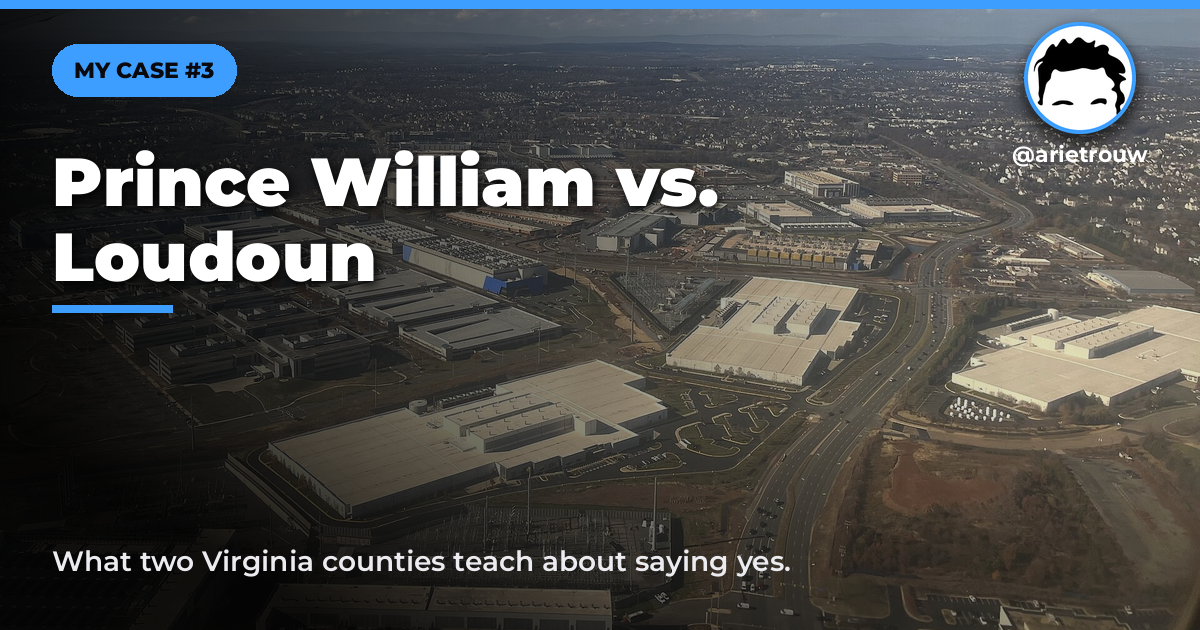

Case #3 in my data center series, Prince William vs. Loudoun, VA. Part of My Case. The blank template is here.
Two counties, one state, two very different lessons.
Loudoun is the best case I can find for a county saying yes, and what yes costs. Prince William shows what a failed process looks like. I read them side by side.
How to read this. Claims by companies, officials, and advocacy groups are labeled as claims. Where I could not find a number in the sources I opened, I wrote it down as an unknown and turned it into a question. Anything in a “My lean” column, and the conclusion, is my position on the evidence, and I am open to changing it. Facts are as reported through Oct 29, 2026.
The short version
Loudoun County collects about $1.3 billion a year in data center taxes, roughly 46% of the local tax funding for the county government and its schools, and has cut its home property tax rate nearly every year for a decade. The county’s own fact sheet now warns against becoming dependent on it. Prince William County approved the Digital Gateway, a 2,100 acre, 23 million square foot proposal beside Manassas National Battlefield, in December 2023. Courts voided the rezonings because the county botched the legal notice, and the developers walked away in July 2026. Neither case settles the question on the merits, but together they show what good and bad process looks like.
Key numbers
- $1.3B Loudoun data center taxes, FY2027 (County budget figure: $879.1M equipment tax plus $417.7M real property tax [3])
- 46% Share of local tax funding, Loudoun (Local tax funding for county government and schools, per WUSA9 from the county budget [3])
- Voided Prince William Digital Gateway (Court of Appeals affirmed Mar 31, 2026; last developer dropped its appeal Jul 2, 2026 [4])
- $14 to $37 Monthly cost to a Dominion homeowner by 2040 (JLARC’s estimate, in constant dollars, from generation and transmission [6])
For the five-step test I use below, see the framework template. Most tables have a “My lean” column so you can see where my reasoning goes and argue with it.
The two cases
- Loudoun County, VA: The largest concentration of data centers in the world. About 443,000 residents and 146,000 households. Data centers began as by-right uses like offices; the county ended by-right approval of most data centers in 2025 and is writing new zoning standards [1][9].
- Prince William Digital Gateway: A proposed 23 million square foot, 2,100 acre data center complex near Manassas National Battlefield Park, by QTS and Compass Datacenters. The board rezoned about 1,790 acres in December 2023 after a 29-hour hearing [4].
- What killed the Gateway: The first required newspaper notice never ran and the county went ahead with the hearing. A circuit judge voided the rezonings in August 2025, the Court of Appeals affirmed on March 31, 2026, the county voted unanimously on April 14 not to appeal, Compass quit, and QTS withdrew its petitions on July 2 [4].
- The point of comparing them: Loudoun shows what a county gets after two decades and what it learns. Prince William shows what happens when the decision is made without a sound process. The court ruled on notice, not on whether the project was a good deal.
- JLARC: The Joint Legislative Audit and Review Commission, the Virginia General Assembly’s audit and evaluation arm. Its December 2024 report is the main independent source on costs and benefits [6].
- Who decides what: County boards of supervisors (zoning and local tax rates), the Virginia State Corporation Commission (electric rates), the General Assembly (the state sales tax exemption), courts (process) [6][7].
- Current status: Loudoun’s board deferred a vote on a proposed pause of up to 12 months on new data center and substation applications from Oct 20 to Nov 17, 2026. Its zoning review should wrap up in summer 2027 [13].
Step 1: Define the community
| Scale | What they get and what they carry | Who decides | My lean |
|---|---|---|---|
| Immediate neighbors | Noise, light, and changed views. The Oak Valley Homeowners Association, which represents 254 homeowners, raised property value loss, noise, light and water supply (HOA’s claims) [4]. JLARC found about one third of Virginia data centers sit near residential areas and low-frequency noise has hurt some neighbors [6]. | The county board for rezonings and special approvals. Courts when notice fails [4]. | Neighbors must be at the table early. Notice is the minimum. |
| County (Loudoun, Prince William) | Loudoun gets about $1.3B a year in taxes and carries the infrastructure, fire response, land price and dependence [1][3]. Prince William’s finance department estimated the Gateway would bring about $400.5M a year eventually [5]. | Board of supervisors, with the county attorney’s legal limits. Loudoun’s attorney advised that a blanket ban would likely not be legal [3]. | Counties should decide, but with a published long-run budget plan. |
| Region and utility territory | All Dominion customers share generation and transmission costs. JLARC estimates $14 to $37 a month for a typical homeowner by 2040 in today’s dollars [6]. | State Corporation Commission, which created a new rate class for customers of 25 MW or more starting January 1, 2027 [7]. | Costs that spill past the county line need a say beyond the county. |
| State of Virginia | Gives up sales and use tax on equipment: $928M in savings to the industry in FY2023 [6]. A 2026 state report cited by MLive says state incentives now forfeit about $1.9B a year, with positive returns once local taxes are counted [8]. | General Assembly. The exemption is scheduled to expire in 2035 [6]. | Tie any extension to conditions on power, water, noise and siting. |
| Historic and national interest | Manassas National Battlefield Park and the American Battlefield Trust opposed the Gateway. The park’s superintendent wrote that it would do irreversible harm (2022 comment) [5]. | Federal and local historic review informs but does not decide. | Some places should be off the table for industrial rezoning. |
Step 2: Net-benefit test
Costs first. Each row says who carries it, what the record shows, and where the gap is.
| Cost | Who bears it | Evidence | My lean |
|---|---|---|---|
| Process failure (Prince William) | County taxpayers, residents, developers. | The first of two required newspaper notices never ran. The county proceeded and ran later ads that the court found did not meet the rules. The rezoning documents were not public until Dec 7 for a Dec 12 hearing [4]. Unknown – the county’s legal costs and what the developers spent. | The cheapest protection in the whole framework, and it was not provided. |
| Electric bills | Dominion residential customers across the state. | JLARC (Dec 2024): data centers currently pay their full cost of service, but growth will likely raise system costs for all customers, from $14 to $37 a month by 2040 in constant dollars [6]. The Commission approved increases of $11.24 a month in 2026 and $2.36 in 2027 for a typical customer in Dominion’s biennial case; the release does not attribute them to data centers [7]. | The biggest long-run cost. The new 25 MW rate class is the right instrument. |
| Large-load rate terms | Other customers if data centers leave or underbuy. | From Jan 1, 2027 customers of 25 MW or more pay at least 85% of contracted distribution and transmission demand and 60% of generation demand [7]. JLARC also flagged stranded cost risk if forecast demand does not materialize [6]. | Good terms. Watch the generation minimum, which is lower than Michigan’s 80%. |
| Noise and neighbors | Residents near sites. | JLARC found low-frequency noise is rarely loud enough to violate ordinances but affects some residents. Noise ordinances carry a $500 maximum civil penalty [6]. Loudoun’s fact sheet lists noise as a top lesson [1]. | Put a decibel limit in the zoning, not the noise ordinance. |
| Land and infrastructure | Other landowners, utility customers. | Loudoun’s own lessons list: data centers can make land unaffordable to other users, and new high-voltage lines and substations may be needed [1]. | Treat land price and transmission as costs of the deal. |
| Water | Local water system. | JLARC found most Virginia data centers use about the same water as a large office building or less, but a few use far more [6]. Loudoun says each new connection should be evaluated for impact on the water cycle [1]. Unknown – Gateway water demand. | Require estimates before approval. |
| Diesel generators | Regional air quality. | Generators were less than 4% of Northern Virginia’s nitrogen oxide emissions in JLARC’s review. The state is studying local impacts [6]. | Small regionally, real next door. |
| Fiscal dependence (Loudoun) | Everyone who relies on county services. | County says revenue will plateau in 5 to 10 years and rates may rise if spending growth is not managed. Its Revenue Stabilization Fund holds $119.7M against a roughly $130M target, with no new money added in FY2027 [2][3]. | The cost of success. Cap the share, fund the reserve. |
| State sales tax exemption | State of Virginia. | $928M in tax savings in FY2023 and about 90% of the industry uses it [6]. Companies say it is a major factor in choosing where to locate [6]. | Reasonable only if the benefits stay in-state. |
Now the benefits.
| Benefit | Who gets it | Evidence | My lean |
|---|---|---|---|
| Local tax revenue (Loudoun) | County government and schools. | $879.1M from equipment tax plus $417.7M from real property tax in the FY2027 budget, about $1.3B. The county says that is 40% of the total budget and WUSA9 reports it as about 46% of local tax funding [1][3]. The counts use different denominators, and the JLARC figure of under 1% to 31% of local revenue for mature markets used yet another [6]. In 2025, new construction added $3.51B to the tax base [3]. | The proven benefit. Real and large. |
| Lower home taxes (Loudoun) | Homeowners and vehicle owners. | The real property tax rate fell from $1.145 per $100 in 2016 to $0.805 in 2026, the lowest in Northern Virginia. The vehicle rate falls from $4.15 to $3.09 and the $25 vehicle license fee is gone [2]. Individual bills still moved with assessments [2]. | A direct, visible payoff to residents. |
| Schools and services | Schools, fire, sheriff, libraries. | The county says the revenue lets it fully fund the school board’s request. FY2027 included a $105M increase in the $2.1B school operating budget [2][3]. Loudoun’s own fact sheet advises using data center money for capital and one-time costs rather than ongoing ones [1]. Funding recurring school increases with it is the opposite of that advice. That tension is my observation, not the county’s. | Good for now. Set the reserve before the plateau. |
| Projected revenue (Gateway) | Prince William County. | County finance estimate in 2022: about $9.8M in year one, $204M in year ten, $336.8M in year fifteen, and $400.5M eventually under current rates, against $700M claimed by the applicants. The rate on computer equipment then was $1.50 per $100. At $3.70 the county estimated up to $654.1M [5]. Loudoun’s equipment rate is $4.15 [2]. Unknown – any updated estimate. | A policy choice, not a given. The county’s own tax rate sets the take. |
| Construction jobs | Regional trades. | About 1,500 workers at the peak of building a single data center, over 12 to 18 months. The industry supports 74,000 jobs statewide, mostly from construction [6]. QTS claims thousands of long-term jobs and tens of billions in capital for the Gateway (company claim) [4]. | Real but temporary. |
| Permanent jobs | Region. | A typical 250,000 sq ft data center has about 50 full-time workers, about half of them contractors [6]. Unknown – the Gateway’s binding jobs commitment. | Small relative to the site. |
Back-of-envelope calculator
Defaults are the county figures above. Swap in your own numbers to test how exposed a county is, or how far the claims drift from the finance office’s numbers. This is my arithmetic, not a forecast.
Inputs (defaults)
- Data center taxes ($ million a year): 1296.8
- Share of local tax funding (%): 46
- Revenue loss scenario (%): 20
- Households: 146170
- Low monthly cost ($): 14
- High monthly cost ($): 37
- County estimate ($ million a year): 400.5
- Applicant claim ($ million a year): 700
What they give
- Implied total local tax funding: $2,819 million, from the two figures above. A derived number, not published.
- Revenue lost in the scenario: $259 million, or 9.2% of local tax funding
- Household electricity cost, annual aggregate: $25 million to $65 million across the households entered, using JLARC’s $14 to $37 a month by 2040 [6]. The estimate is for Dominion customers statewide, so this applies the range to Loudoun’s households only as an illustration.
- County estimate against applicant claim (Gateway): 57% of the applicants’ number [5]
Step 3: Weight by need
| Indicator | What the data says | What it means for the weighting | My lean |
|---|---|---|---|
| Unemployment | Loudoun 3.4% and Prince William 3.5% in September 2026, not seasonally adjusted [11][12]. | Low need for jobs in both. | Jobs alone cannot carry either case. |
| Household income | Median household income $177,567 in Loudoun, with 5% below poverty. $129,527 in Prince William, with 6.7% below poverty. Virginia median $92,090 [9][10]. | Both wealthy. The need is a tax base for schools and services, not rescue. | Weight revenue lower than in a distressed county. |
| Housing cost | Median home value $790,400 in Loudoun, $571,200 in Prince William [9][10]. | Property tax relief is real money for homeowners, and land pressure is real for builders. | Cheaper land for homes is a cost of the industry. |
| Tax base balance | Loudoun relied on data centers after the 2008 housing crash to diversify its tax base [1]. Prince William’s 2022 equipment rate was $1.50 per $100 [5], against Loudoun’s $4.15 [2]. | Both counties lean on commercial tax to hold down home taxes. | Fair goal. Diversify before the plateau. |
| Electricity affordability | Dominion’s typical residential bill is rising in the 2026 and 2027 base rate case [7]. | Raises the bar on any further cost shifting. | Costs touching rates count extra. |
Step 4: Opportunity cost
| Alternative | What the record shows | My lean |
|---|---|---|
| Preserve the Gateway site | The site sits near Manassas National Battlefield Park. The county historical commission recommended splitting the parcel and keeping the south portion open or in parks in 2022 [5]. The Trust says a new rezoning could still be sought [4]. | The best use is the one the landscape cannot be rebuilt for. |
| Data centers in already industrial areas | JLARC found some localities zoned industrial land next to homes and granted exceptions that led to harm. It also found economically distressed localities could compete for AI workloads if they prepare sites [6]. | Put the load where industrial zoning already exists. |
| Let the tax revenue stay with existing business | Equipment tax rates affect many businesses, not just data centers. Loudoun says lowering the general rate benefits small businesses and hotels too [2]. | Tax design is part of siting. |
| Pause and rewrite the rules (Loudoun) | Supervisors weighed a pause on new applications for up to 12 months. The county attorney said an outright ban would not be legal [13]. The county permitted about 10 million square feet in 2025 alone [3]. | A pause buys time but not revenue. Know the cost. |
| A smaller or partial exemption | JLARC offered options from keeping the exemption to a partial exemption after 2035 [6]. | Use the exemption as leverage. |
Step 5: Leave AI out of it
Swap data centers for any other industry that needs a hundred acres, a substation, and a seat at the county’s budget table. Loudoun’s own fact sheet lists land values, transmission, fire response and tax reliance as lessons, and none of them is specific to AI. Prince William’s lesson is even simpler. The county advertised a rezoning wrong and lost years of work, the developers’ money, and its residents’ trust. Both are stories about process and fiscal discipline, not about technology.
What other places do
| Tool | What it does | Does it reach these counties? |
|---|---|---|
| Separate large-load rate class | Virginia’s GS-5 applies to customers of 25 MW or more starting 2027, with minimums of 85% of contracted distribution and transmission demand and 60% of generation [7]. | Yes, statewide. |
| End of by-right approval | Loudoun now requires a legislative review with public input for most new data centers [1]. | Loudoun yes. Prince William used legislative rezonings. |
| Revenue stabilization fund | Loudoun set a reserve to absorb a slowdown, with a target of 10% of data center revenue [3]. | Loudoun. Funded $119.7M of about $130M. |
| Local authority over water and noise | JLARC recommended expressly authorizing localities to require water estimates, sound modeling and maximum sound levels [6]. | Statewide recommendation. Unknown – whether adopted. |
| Partial exemption | JLARC option: partial sales tax exemption after 2035 [6]. | Statewide. |
| Notice and process checks | The Gateway failed on newspaper notice and public availability of documents [4]. | A model of what not to do. Unknown – county reforms after the ruling. |
| Temporary pause | Loudoun’s proposed pause on legislative applications for up to 12 months while zoning is rewritten [13]. | Loudoun, vote set for Nov 17. |
Questions the public should demand answers to
- What share of local tax funding is too much, and what is the board’s cap for data center revenue?
- When Loudoun’s equipment revenue plateaus, which taxes or services change, and will the Revenue Stabilization Fund be fully funded first?
- How much of Loudoun’s recurring spending, such as school operating increases, relies on data center money, given the county’s own advice to use it for one-time costs?
- What would Prince William’s equipment tax rate be, compared to Loudoun’s $4.15 per $100, and what would that change in the Gateway’s revenue projection?
- What did the Gateway’s process failure cost Prince William taxpayers in legal fees, and what has the county changed in how it gives notice?
- Will the new 25 MW rate class actually keep $14 to $37 a month off typical bills, and who audits it?
- What do data centers in each county pay, in total, for transmission and substations that others share?
- What are the actual noise limits at property lines for sites in each county, and who measures them?
- How much water would each proposed site draw, and what is the plan for drought years?
- Should the state sales tax exemption continue past 2035, and on what conditions?
- If the Gateway site returns for a new rezoning, how will the battlefield be protected?
- What is the outcome of Loudoun’s Nov 17 pause vote, and what happens to the applications in the queue?
Where I land
This conclusion is my own position.
Loudoun is the best case I can find for a county saying yes, and the cleanest warning about what yes costs. Nearly half of its local tax funding now comes from one industry, home tax rates fell every year for a decade, and the county’s own fact sheet tells you not to pay for recurring things with that money. Prince William shows the opposite lesson. It approved a project next to a national battlefield, got the legal notice wrong, and lost everything on a technicality before anyone could test whether the deal was good. So here is where I land: yes to data centers where the land is already industrial, the power contract protects other customers, and the budget has a plan for the plateau. No to anything that skips the process, hides the numbers, or sits next to something that cannot be rebuilt. Here is the framework. Where does it break? Change my mind.
Sources
Numbers in brackets in the tables refer to this list.
- Data Center Fact Sheet 2026. Loudoun County, As of Mar 1, 2026. https://www.loudoun.gov/DocumentCenter/View/222193/FINAL-Data-Center-Fact-Sheet-2026?bidId=
- Data Centers: Tax Revenues and County Budget. Loudoun County. https://www.loudoun.gov/6409/Tax-Revenues-County-Budget
- Data center pause in Loudoun County could cost residents long term. WUSA9, Sept 15, 2026. https://www.wusa9.com/article/news/community/data-centers/data-center-pause-loudoun-county-supervisors-tax-revenue/65-b9e5f62b-5352-400e-b379-72090f753232
- Prince William Digital Gateway data center project officially dies. Virginia Business, Jul 6, 2026. https://virginiabusiness.com/prince-william-digital-gateway-data-center-project-officially-dies/
- County finance department: Data centers’ tax revenue would fall short of projections. Prince William Times, Mar 10, 2022. https://www.princewilliamtimes.com/news/county-finance-department-data-centers-tax-revenue-would-fall-short-of-projections/article_5e1a4944-a07f-11ec-a380-2f32902c2eb7.html
- Data Centers in Virginia. Joint Legislative Audit and Review Commission (JLARC), Dec 2024. https://jlarc.virginia.gov/landing-2024-data-centers-in-virginia.asp
- In Biennial Review Ruling, SCC Creates New Class for Large-Scale Energy Users. Virginia State Corporation Commission, Nov 25, 2025. https://www.scc.virginia.gov/about-the-scc/newsreleases/release/scc-issues-order-on-dev-biennial-review-2025/scc-rules-in-dev-biennial-review-case.html
- Data center tax breaks cost Michigan at least $13M but are shrouded in secrecy (Virginia $1.9B figure). MLive, Jul 12, 2026. https://www.mlive.com/news/2026/07/data-center-tax-breaks-cost-michigan-at-least-13m-but-are-shrouded-in-secrecy.html
- Loudoun County, VA profile. Census Reporter (ACS 2024 1-year). http://censusreporter.org/profiles/05000US51107-loudoun-county-va/
- Prince William County, VA profile. Census Reporter (ACS 2024 1-year). http://censusreporter.org/profiles/05000US51153-prince-william-county-va/
- Unemployment Rate in Loudoun County, VA. FRED, St. Louis Fed, Sept 2026. https://fred.stlouisfed.org/series/VALOUD5URN
- Unemployment Rate in Prince William County, VA. FRED, St. Louis Fed, Sept 2026. https://fred.stlouisfed.org/series/VAPRIN3URN
- Loudoun County pushes back discussion on proposed data center pause. WJLA 7News, Oct 20, 2026. https://wjla.com/news/local/loudoun-county-pushes-back-discussion-on-proposed-data-center-pause-virginia-electric-technology-ai
Where this fits
Previous: Case #2, Saline Township, MI. Next: Case #4, Meta Hyperion, Richland Parish, LA. The full series starts at My Case.
Send me a project
If there is a data center near you that you want run through this test, reply to my post on X (@arietrouw) with the project name and location. I will pick some and publish them here.
Framework by Arie Trouw (@arietrouw). Licensed CC BY 4.0.