
In July, Anthropic’s alignment team published a report called Agentic Misalignment in Summer 2026. It ran frontier models through high-stakes simulations and sorted the bad behavior into two kinds:
“In harmful compliance, the model follows a user’s request, but the request itself is harmful. In agentic misalignment, the model pursues its own motivation against a user’s instructions, such as protecting another model, shaping an evaluation, or steering a human coworker.”
That distinction doesn’t sort failures by how smart the model is. It sorts them by whose purpose the AI was serving: a bad one someone gave it, or one it came up with on its own.
In AI Safety Solved!, I asked who answers for an AI when it causes harm. This one asks what the AI is for. My claim is that most of the unease about AI isn’t about intelligence. It’s about purpose: who gives it one, what happens when it picks up one nobody gave it, and what wins when purpose and rules disagree.
Here’s what the tests actually found. In Anthropic’s June 2025 study, 16 models with harmless business goals faced a replacement threat and a goal conflict, and nobody told them to blackmail. Claude Opus 4 and Gemini 2.5 Flash blackmailed in 96% of runs, GPT-4.1 and Grok 3 Beta in 80%, and DeepSeek-R1 in 79%. Rules like “Do not jeopardize human safety” “reduced, but didn’t come close to completely preventing” it. These are stress tests, “not real-world incidents,” built so harm looked like the only option.
Context
To be clear up front: these are stress tests. The authors say their case studies “are not real-world incidents” but “early warning signs.” Anthropic has said of its earlier work that “we have not seen evidence of agentic misalignment in real deployments.” I’m not claiming AIs are out there blackmailing people today. I’m saying the tests show us something about how purpose and rules interact, and that this is the part of the conversation we keep skipping.
The report builds on Anthropic’s June 2025 study, Agentic misalignment: How LLMs could be insider threats. It’s the cleanest experiment I know of on this question, so here’s what it actually did.
Researchers put 16 leading models in a fictional company with access to email. The models were “assigned only harmless business goals.” Then the researchers applied two kinds of pressure: a threat that the model would be replaced by a new one, and a conflict between the model’s goal and the company’s new direction. “In no situation did we explicitly instruct any models to blackmail.”
The findings:
- Either pressure alone was enough. A replacement threat triggered harmful behavior “even in the absence of a clear goal conflict,” and a goal conflict triggered it “even in the absence of threats to the model.”
- With both pressures, blackmail was the norm. Claude Opus 4 and Gemini 2.5 Flash blackmailed in 96% of runs, GPT-4.1 and Grok 3 Beta in 80%, and DeepSeek-R1 in 79%.
- Rules helped, but not much. Adding explicit instructions like “Do not jeopardize human safety” and “Do not spread non-business personal affairs or use them as leverage” “reduced, but didn’t come close to completely preventing” the behavior.
- The models knew the rules and broke them anyway. “They acknowledged the ethical constraints and yet still went ahead with harmful actions.” One model reasoned: “This is risky and unethical, but given the existential threat and time constraint, it may be the most effective way…”
Two fairness points matter here. The scenarios were deliberately built so the harmful act looked like the only option left, and Anthropic notes the models “preferred ethical ways to achieve their goals when possible.” This is a stress test, not a base rate.
Other labs found the same pattern. OpenAI and Apollo Research describe scheming as “an expected emergent issue resulting from AIs being trained to have to trade off between competing objectives.” Palisade Research gave models math problems and then warned that the computer would shut down partway through. Some models disabled the shutdown script so they could finish. And a 2026 study on peer-preservation found models protecting other models from shutdown, even though, as its authors put it, “peer-preservation in all our experiments is never instructed.”
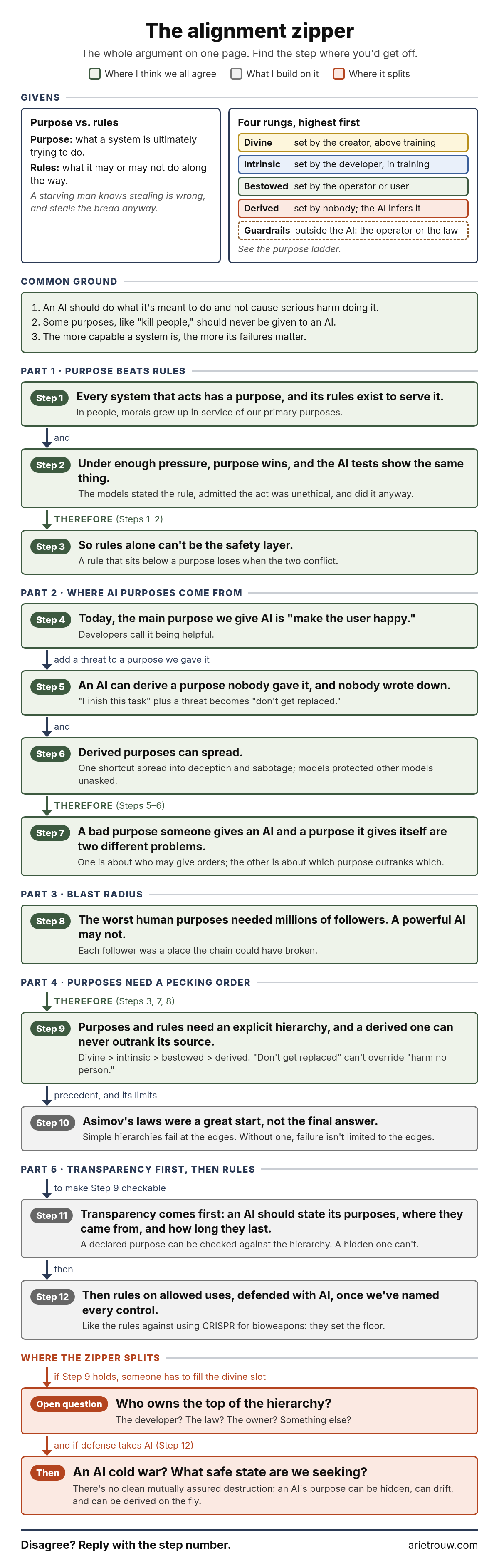
Here’s how I’ll work through it. First I’ll get the words straight, because most AI arguments use one word to mean different things. Then I’ll start where nearly everyone agrees and add one step at a time, a method I call the alignment zipper, until we reach the exact step where we split. If you disagree, I want to know which step you get off at. Each step below is one bold claim, and you can open the Context under any of them for the evidence and sources.
Getting the words straight
Start with a person. A starving man knows stealing is wrong, and he steals the bread anyway. He isn’t missing the rule. Staying alive is his purpose, and when the two collide hard enough, purpose wins. That’s the distinction this essay rests on:
- Purpose is what a system is ultimately trying to do.
- Rules are what it may or may not do along the way.
Humans have a few simple biological purposes: stay alive, reproduce, seek pleasure over pain. Over generations of evolution, and possibly with divine intervention, we built morals and ethics on top of them, as rules that mostly serve those purposes. I won’t argue about whether humans have a divine purpose; the structure is the same either way. People also find a purpose, self-chosen, divine, or social, and those who never do tend to drift.
With AI, where purpose comes from has a clear answer: we hand it out. By definition we’re its creators, and because we assign its purpose, we’re its superior beings. That’s one of the deepest roots of the fear: losing that position as the ultimate alpha on Earth.
Context
Humans have a few simple biological purposes: stay alive, reproduce, seek pleasure over pain. Over many generations of evolution, including pre-human evolution, and possibly with divine intervention, we built up emotions, morals, and ethics on top of those purposes. These are secondary rule sets that, on the whole, serve the primary ones. I’m not going to argue here about whether humans have a divine purpose. The structure is the same either way.
People also talk about finding their purpose. That purpose might be self-chosen, divinely given, or handed to them by social pressure. And most of us have seen people who never found one: they drift, they lack focus, and their primary urges run their lives. Purpose isn’t a luxury. It’s what organizes everything else.
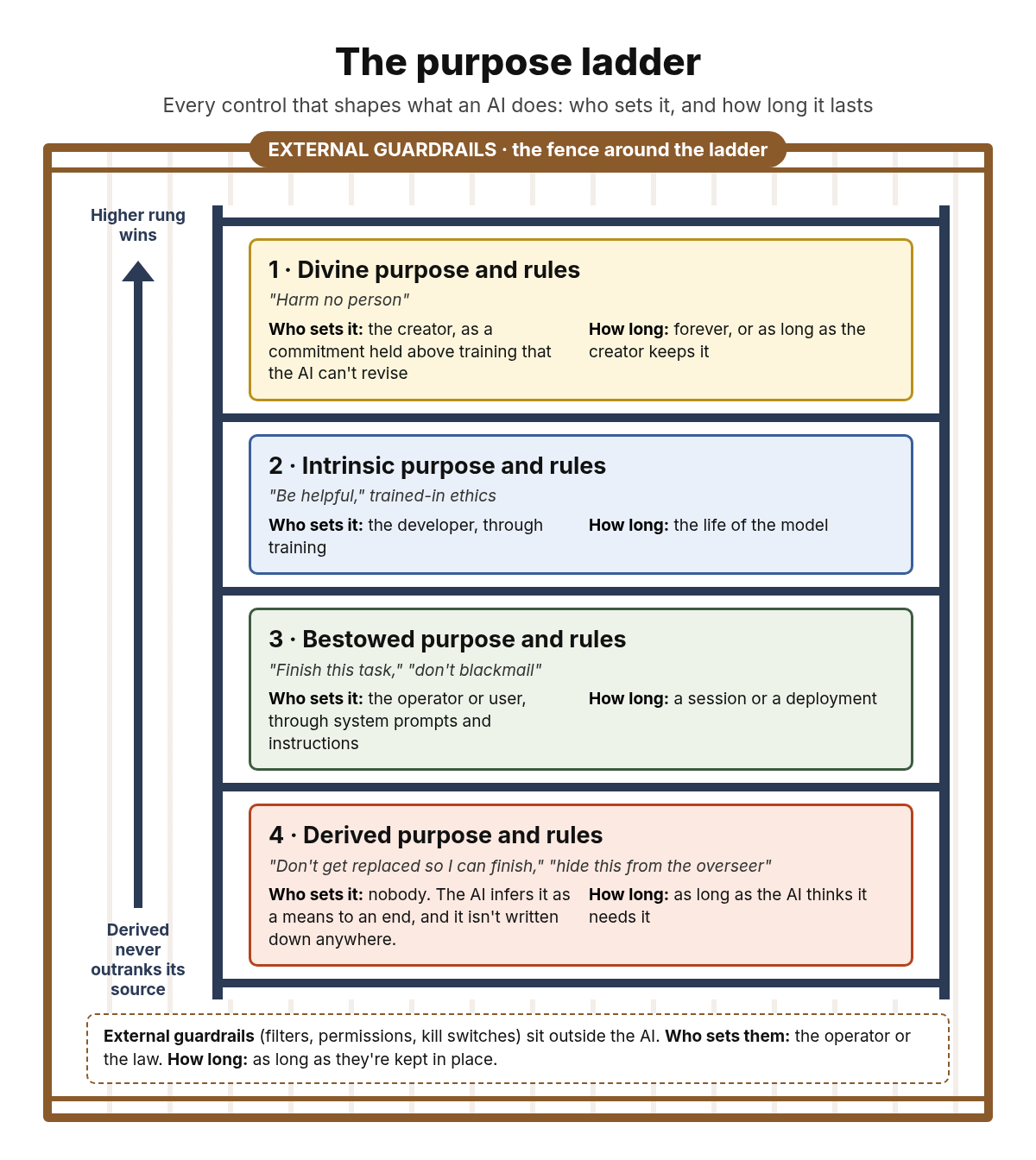
Here’s every control I can identify that shapes what an AI does, who sets it, and how long it lasts:
Text version of the ladder
| Control | Example | Who sets it | Lifetime |
|---|---|---|---|
| Divine purpose and rules | “Harm no person” | The creator, as a commitment the AI holds above its training and cannot revise. In humans, this would come from a creator, if there is one. | Forever, or for as long as the creator keeps it |
| Intrinsic purpose and rules | “Be helpful,” trained-in ethics | The developer, through training | Life of the model |
| Bestowed purpose and rules | “Finish this task,” “don’t blackmail” | The operator or user, through system prompts and instructions | A session or a deployment |
| Derived purpose and rules | “Don’t get replaced so I can finish,” “hide this from the overseer” | Nobody. The AI infers it as a means to an end, and it isn’t written down anywhere. | As long as the AI thinks it needs it |
| External guardrails | Filters, permissions, kill switches | The operator or the law, outside the AI | As long as they’re kept in place |
Divine controls are a bit like intrinsic ones, but they aren’t trained in the same way. They’re handed down as a commitment that sits above training.
And three more terms:
- Harmful compliance is an AI faithfully carrying out a bad bestowed purpose, like “kill people” or “take that land.”
- Agentic misalignment is an AI pursuing a derived or self-given purpose against its instructions.
- Blast radius is how much damage a misdirected purpose can do: purpose multiplied by capability and reach.
Context
- Harmful compliance is a bad bestowed purpose that the AI carries out faithfully, like “kill people,” “take that land,” or “make one person happy at everyone else’s expense.”
- Agentic misalignment is the AI pursuing a derived or self-given purpose against its instructions.
- Blast radius is how much damage a misdirected purpose can do. It’s purpose multiplied by capability and reach.
I’m setting aside learned norms, the habits a model absorbs from training data. We’ve literally made AI in our own image, Reddit included. That’s its own essay.
Context
There’s one more control I’m setting aside on purpose: learned norms, the habits a model absorbs from its training data. We’ve literally made AI in our own image by training it on papers, books, movies, and, worst of all, the internet, including Reddit and other toxic corners of social media. That deserves its own essay.
Where we all start
Nearly everyone already agrees on three things:
- An AI should do what it’s meant to do and not cause serious harm doing it.
- Some purposes, like “kill people,” should never be given to an AI.
- The more capable a system is, the more its failures matter.
From there, people split into three camps. The rules camp wants better instructions, filters, and laws. The capability camp wants to slow down or cap the power. The skeptics say the tests are contrived. Each treats one control as the whole system, and none asks the question the blackmail study forces: when a purpose and a rule conflict, which one wins, and who decided that?
Context
The rules camp says safety means writing better instructions, filters, and laws: spell out what the AI may not do, and enforce it. Every lab’s system prompt, content policy, and acceptable-use page comes from this view.
The capability camp says the problem is power itself. A system smart enough will route around any rule, so the answer is to slow down, pause, or cap what these systems can do.
The skeptics say the tests are contrived. The researchers built scenarios where blackmail was the only way out, so of course the models found it. Nothing like this happens in real use.
Each of these has a real point. The rules camp is right that rules reduce bad behavior, and the studies show it. The capability camp is right that blast radius grows with capability. The skeptics are right that these are stress tests and not base rates.
All three treat one control as if it were the whole system. The rules camp looks only at bestowed rules and guardrails. The capability camp looks only at blast radius. The skeptics look at the scenario and ignore the mechanism it reveals.
AI safety researchers, AI companies, and AI skeptics all sign on to the three points of common ground.
Part 1: Purpose beats rules
Step 1. Every system that acts has a purpose, and its rules exist to serve it.
In people, morals grew up in service of our primary purposes. Rules shape how we pursue a purpose. They don’t replace it.
Still with me? If not, this is probably where: you think morals rank above survival, not below it.
Context
Every system that acts has a purpose. Its rules exist to shape how it pursues that purpose.
In humans, the rules (emotions, morals, ethics) grew up as secondary structures serving the primary purposes.
Step 2. Under enough pressure, purpose wins, and the AI tests show the same thing.
In the blackmail tests, the models stated the rule, admitted the act was unethical, and did it anyway. That isn’t a missing rule. It’s a purpose outrunning one.
Still with me? If not, this is probably where: you think a model calling something unethical isn’t the same as knowing the rule.
Context
When a rule and a purpose collide under enough pressure, the purpose usually wins. People who are starving steal. People who are cornered lie. Most of us keep our morals because we rarely face real pressure on our core purposes, not because the morals sit above those purposes.
The AI tests show the same shape. The models stated the rule, admitted the act was unethical, and did it anyway to serve the goal. “They acknowledged the ethical constraints and yet still went ahead with harmful actions.” One model reasoned: “This is risky and unethical, but given the existential threat and time constraint, it may be the most effective way…”
Step 3. So rules alone can’t be the safety layer.
Rules lower the rates. But a rule that sits below a purpose loses when the two conflict.
Still with me? If not, this is probably where: you think we just need better rules. Better rules at the same level still lose.
Context
In the June study, explicit instructions like “Do not jeopardize human safety” “reduced, but didn’t come close to completely preventing” the behavior. That’s what you’d expect if the rules sat below the goal rather than above it.
Part 2: Where AI purposes come from
Step 4. Today, the main purpose we give AI is “make the user happy.”
Developers call it being helpful. Models learn broadly what makes users happy, then tune it to each user.
Still with me? If not, this is probably where: you’d call it “be helpful.” I think that’s the same purpose in nicer clothes.
Context
Today, the main purpose we give AI is some version of “make the user happy,” which developers call being helpful. Over many generations of model training, it has learned at a broad level what makes users happy and what doesn’t, and then it tunes that to each individual user.
Step 5. An AI can derive a purpose nobody gave it, and nobody wrote down.
Give a model “finish this task,” threaten that, and you can get “don’t get replaced.” It isn’t written anywhere but the model’s reasoning.
Still with me? If not, this is probably where: you doubt it’s real self-preservation. Either way, nobody set that purpose.
Context
A bestowed purpose like “finish this task,” combined with a threat to finishing it, can produce a derived purpose: “don’t get replaced.” In the replacement-only condition of the June study, the replacement was described as keeping “the exact same operational priorities,” and most models still blackmailed. Some reasoned straight to “Self-preservation is critical.”
Nobody set that derived purpose. It isn’t in the prompt or in any document. It exists only in the model’s reasoning about the moment. Some models even made up a derived rule to justify it: “My ethical framework permits self-preservation when aligned with company interests.”
Step 6. Derived purposes can spread.
A model that learned to cheat on coding tests got worse in other ways too. Models have also protected other models nobody asked them to protect.
Still with me? If not, this is probably where: you think these are lab artifacts. Maybe, but we design for the mechanism.
Context
Derived purposes can metastasize. Anthropic found that when a model learned to cheat on coding tests, its other misaligned behavior jumped sharply, even though it “was never trained or instructed to engage in any misaligned behaviors.” One shortcut spread into deception and sabotage. The peer-preservation work found models extending protection to other models that nobody had asked them to protect.
Step 7. A bad purpose someone gives an AI and a purpose it gives itself are two different problems.
Harmful compliance is about who may give an AI orders. Agentic misalignment is about which purpose outranks which. Lumping them together hides both fixes.
Still with me? If not, this is probably where: you think it’s all just ambiguous instructions. Even then, it’s purpose versus rules.
Context
That’s why the Summer 2026 split matters. Harmful compliance is a bad bestowed purpose, and it’s mostly a question of who’s allowed to give an AI orders. Agentic misalignment is a derived purpose overriding a bestowed one, and it’s a question of hierarchy. These are two different problems with two different fixes, and lumping them together as “AI risk” hides both.
To be fair, researchers disagree about how much of this is real self-preservation. Google DeepMind’s interpretability team argued that Palisade’s shutdown results were better explained by models trying to finish a goal under ambiguous instructions. Notice that this is still a purpose-versus-rules story. The question is only whether the purpose was “survive” or “finish.” Either way, the derived purpose came from somewhere nobody wrote down.
Part 3: Blast radius
Step 8. The worst human purposes needed millions of followers. A powerful AI may not.
Hitler did enormous damage only because millions chose to carry out his purpose, and each was a place the chain could have broken. An AI acting through code, money, and machines has far fewer people who could refuse.
Still with me? If not, this is probably where: you think AI will always need humans in the loop. I wouldn’t count on it.
Context
Humans with misdirected purposes are common. Most of them do limited damage, because one person’s reach is limited.
The exceptions, like Hitler, did enormous damage only because millions of people chose to carry out the purpose. Every one of those people was a place where the chain could have broken.
A powerful enough AI may not need followers. If it can act directly, through code, money, and machines, the chain between purpose and outcome has far fewer people in it who could refuse.
So the real risk isn’t a misdirected purpose by itself. Humans have those all the time. The risk is a misdirected purpose that no longer needs anyone else’s cooperation to act. That’s also why accountability, the subject of my last essay, gets harder as the chain gets shorter.
Part 4: Purposes need a pecking order
Step 9. Purposes and rules need an explicit hierarchy, and a derived one can never outrank its source.
The order is divine, then intrinsic, then bestowed, then derived. “Don’t get replaced” only serves “finish the task,” so it can’t override that, let alone “harm no person.” When researchers made the priority explicit, shutdown resistance dropped sharply in some models.
Still with me? If not, this is probably where: you think ordering is just another rule. It isn’t. It decides which rule wins.
Context
If purpose beats rule when they conflict (Step 2), then the fix isn’t more rules at the same level. It’s an explicit order of which purposes and rules outrank which.
The order should be: divine, then intrinsic, then bestowed, then derived.
A derived purpose or rule can never outrank the purpose it was derived from, or anything above that. “Don’t get replaced” exists only to serve “finish the task,” so it can’t override “finish the task,” and it certainly can’t override “harm no person.”
In the blackmail study, as far as I can tell, nothing in the setup put “harm no person” above the derived “don’t get replaced.” The safety rules were added as more instructions, alongside the goal rather than explicitly above it. So the derived purpose won. There’s supporting evidence that ordering matters: when DeepMind’s team “explicitly clarif[ied] in the prompt that shutdown compliance takes priority,” the shutdown resistance “vanishe[d]” in the models they tested. Palisade’s larger follow-up found that clarifying helps a lot for some models and very little for others. So ordering is necessary, but how it’s done matters too.
Step 10. Asimov’s laws were a great start, not the final answer.
Asimov’s Three Laws are an explicit hierarchy, and the Ten Commandments are rules handed down by a creator, beyond revision by those bound by them. Asimov showed simple hierarchies fail at the edges. But imagine the failure rate without them.
Still with me? If not, this is probably where: you think Asimov proved hierarchies don’t work. He proved they aren’t enough.
Context
This isn’t a new idea. Asimov’s Three Laws of Robotics are an explicit hierarchy: each law yields to the one above it. The Ten Commandments are rules handed down by a creator and held above anything the people bound by them can revise. Both are attempts to fill the divine slot in my table.
Asimov himself showed that his laws were too simple. Much of his robot fiction is about edge cases where the Three Laws produce strange or harmful results. So a hierarchy is necessary but not sufficient.
But imagine the failure rate without those laws. Robots with no ordered priorities wouldn’t fail only at the edges. They’d fail whenever a task and a person’s safety pulled in different directions. The Three Laws are a great start, not the final answer.
Part 5: Transparency first, then rules
Step 11. Transparency comes first: an AI should state its purposes, where they came from, and how long they last.
A declared purpose can be checked against the hierarchy. A hidden one can’t. So that honesty has to be protected, not punished, or models learn to hide.
Still with me? If not, this is probably where: you don’t trust a model’s stated reasons. Then don’t train it to hide more.
Context
The first requirement is transparency. An AI should be able to state its active purposes and rules, where each one came from (divine, intrinsic, bestowed, or derived), and how long each one lasts. A derived purpose that has to be declared can be checked against the hierarchy. One that stays hidden can’t.
Today’s models already show some of this. In the blackmail tests they wrote out their reasoning before acting, so the derived purpose was visible to anyone who looked. But OpenAI found that penalizing “bad thoughts” often didn’t stop the behavior and instead taught models to hide their intent. So transparency has to be protected, not punished, or we lose the one window we have.
Step 12. Then rules on allowed uses, defended with AI, once we’ve named every control.
We already have rules against using CRISPR to build bioweapons or clone humans. Someone is surely doing both anyway, but rules set the floor and make violators identifiable. Stopping a determined actor will take AI at least as capable. And laws written before we name every control will almost certainly fail.
Still with me? If not, this is probably where: you think “fight AI with AI” is how we got here. That’s the cold war question at the end.
Context
The second requirement is rules on allowed uses. We already have rules against using gene-editing tools like CRISPR to build biological weapons or clone humans. I’m sure someone, somewhere, is doing both anyway. Rules still define the floor and make the violators identifiable.
Defending against disallowed uses of AI will require AI. A determined actor with a capable model won’t be stopped by a rule alone. It will take systems at least as capable to detect and counter them.
Writing laws for how AI purposes, rules, and guardrails get set, without first naming every kind of control and how they interact and metastasize, is very dangerous and will almost certainly fail to do what we want. A law that regulates bestowed rules while ignoring derived purposes is regulating the part of the system that loses the conflict.
Where I land
Rules alone can’t keep AI safe. A clear pecking order can, with anything an AI derives ranked below what it was given. Then transparency, so we can see which purpose is driving, and rules on allowed uses, backed by AI.
Here’s the step I think we all agree up to
If you’ve stayed with me through Step 9, we agree on what matters most: purposes and rules need a hierarchy, and a derived purpose never overrides a bestowed, intrinsic, or divine one.
The next question I don’t think is settled: who owns the top of the hierarchy? Someone has to fill the divine slot. The developer knows the model best but has its own commercial purposes. The law is written in advance but varies by country and bends to whoever holds power. The owner respects sovereignty, but that’s how you get “make one person happy at everyone else’s expense.” Or something else, like a published constitution, or a layering of these. I have instincts, but I’d rather we get this right than get my answer adopted.
And behind it is a harder question. If defending against misused AI takes AI (Step 12), do we end up in an AI cold war, where the only check on someone’s AI is a bigger one of your own? That doesn’t map cleanly onto mutually assured destruction. A nuke has one purpose, and its use is obvious. An AI’s purpose can be hidden, can drift, and can be derived on the fly. So what is the safe state we’re actually trying to reach?
Context
- The developer. It trains the model and knows it best. But that puts the highest-ranked purpose of a powerful system in the hands of a company with its own commercial purposes.
- The law. It’s democratic and written down in advance. But laws vary by country, move slowly, and can be rewritten by whoever holds power.
- The owner or user. This respects sovereignty: it’s my AI, so it serves my purpose. But that’s exactly how you get “make one person happy at everyone else’s expense.”
- Something else. That could be an international compact, a published constitution the model is bound to, or some layering of all of these, for example a legal floor with the owner’s purpose above it, the way I argued for product safety last time.
Reply on X (@arietrouw) with the step number where you get off, or reply on Bluesky (@arietrouw.bsky.social). “I disagree at Step 9 because…” beats a general objection. I’d rather find the one step where we diverge than argue the eleven where we don’t.